Harnessing Microalgae for Biomolecule and Material Production
- Hima Adimulam

- Apr 24
- 3 min read
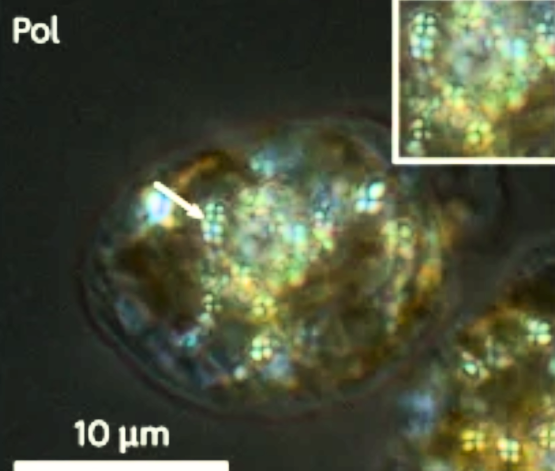
Making eyeglasses and magnifying glasses is more dangerous than you might think. These “lab grade” tools that have been used by nearly every scientist, student, and researcher, may actually contain inorganic substances that can be toxic to humans. Although, scientists have discovered that a particular substance we know and already use throughout our life, could be used for optical tools and the creation of many other items: guanine. One of the four fundamental bases in DNA and RNA, the substance, when crystalized, could be very useful to us outside of our genetic code. However, there is a problem: The molecules are pretty hard to make artificially. Making guanine transparent is quite difficult when it’s only able to mix with a few other compounds. Luckily, scientist Avital Wagner and her team have found a unique solution to producing the substance: microalgae.
The Wonderful World of Complex Cells
Microalgae are microscopic, photosynthetic organisms that can change sunlight and carbon dioxide into a multitude of useful substances. Among the substance list are fatty acids, vitamins, and antioxidants (per the National Library of Medicine), which gives us many more opportunities for biomolecule production than just guanine. They’re already used in many diverse ways, from being a source of bioenergy to power our societies to being used as nanocarriers in humans to deliver cancer treatments! According to the scientific article Harnessing microalgae for the biosynthesis of molecular crystals by Wagner et al., one type specifically used to produce guanine is a type of dinoflagellate (a marine unicellular microalgae), named Amphidinium carterae. Instead of using guanine for visual purposes, the species utilize it to store nitrogen, in case there’s a lack of it in new locations. When a particular nitrogen-starved Amphidinium carterae is fed nitrate or ammonium, the cells turn the extra nitrogen into guanine crystals that we can then use. Basically, scientists are using the microalgae as tiny, biotic factories that can produce crystals tailored to our needs.
How Does This Help Us?
The usage of microalgae to produce guanine crystals has precedents and implications that extend far beyond optical benefits. According to Susan Gawlowicz, a writer for the Rochester Institute of Technology, microalgae grown in wastewater could produce biodiesel for buses and farm equipment to run on, leaving behind clean water for humanity to use as well. Not only are they cheaper to grow than the materials used for ethanol, they are also simply more sustainable for the environment. Furthermore, according to the National Library of Medicine, microalgae can produce substances that have anticancer and anti-microbial properties, which are a key tool in the biomedical and pharmaceutical industries. One type of microalgae, called Diatom, can even serve as nanocarriers to deliver cancer treatments throughout the body.
Using microalgae to produce guanine crystals for optical usage is just one small piece of the puzzle. Microalgae have a wide variety of uses that humans have found, and some that most likely will be found in the future. They’re an incredibly useful tool in the niche of biosynthesis, and an important advance in biotechnology.
Works Cited
Hosny, S., Elshobary, M. E., & El-Sheekh, M. M. (2025). Unleashing the power of microalgae: a pioneering path to sustainability and achieving the sustainable development goals. Environmental Science and Pollution Research. https://doi.org/10.1007/s11356-025-35885-8
Researchers take algae out of the lab. (2018). RIT. https://www.rit.edu/news/researchers-take-algae-out-lab
Khavari, F., Saidijam, M., Taheri, M., & Nouri, F. (2021). Microalgae: therapeutic potentials and applications. Molecular Biology Reports, 48(5), 4757–4765. https://doi.org/10.1007/s11033-021-06422-w
Wagner, A., Margalit, N., Fishman, Y., Indri, S. S., Upcher, A., Baranov, M., Nativ-Roth, E., Hughes, C. E., Kariuki, B. M., Haataja, J. S., Schertel, L., Yates, J. R., Harris, K. D. M., Place, A. R., Mojzes, P., & Palmer, B. A. (2026). Harnessing microalgae for the biosynthesis of molecular crystals. Nature Biotechnology. https://doi.org/10.1038/s41587-026-03006-6


Comments