The Technology and Impacts of Drought Resistant Crops
- Debopriya Ghosh

- May 16
- 3 min read
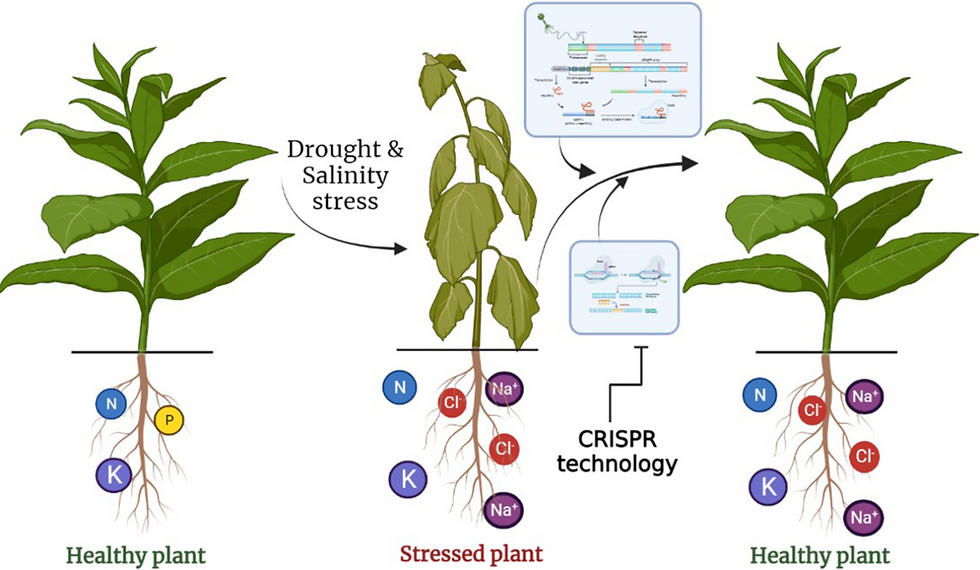
How much of an impact can a drought really have? Bioengineered crops, specifically drought resistant crops, started to develop from 2016 to 2017, and their effect has been huge. Prior to this technology, there have been over 2 billion people affected by famine or famine-related diseases due to mild to severe droughts in just the 20th century. The creation of Drought Resistant crops have greatly decreased famine and death daily. Droughts are unpredictable and inevitable, and finding a well-equipped solution for the drought beforehand is more efficient than trying to scavenge for water while trying to bandaid this disaster at the last minute. The role of gene editing technologies such as CRISPR-Cas9, in the creation of drought resistance in crops has been revolutionary, but the real question is, how does this technology actually work?
How Drought Resistant Crops are Made
The building of drought resistance in crops, for example, feeding plants such as rice, is developed using CRISPR-Cas9, a biotechnology that allows for gene editing in organisms. The process of using CRISPR-Cas9, an enzyme, starts with scientists looking at specific genes on a plant that control the water loss or stress response in an organism: most of the time the stomata of the leaf gets caught as the culprit. The stomata of a plant are pore-like structures on the skin or epidermis of a plant which allows for gas exchange as well as transcription, then take in and release of water vapor. In the case of rice, many scientists have found a way to use CRISPR to reduce the number of stomata on rice plants, thus reducing the water outlet. This causes rice to survive longer in dry conditions and help them to sustain water for longer periods of time. For this to occur,scientists next use CRISPR-Cas9 to find the explicit gene that controls the retainment of water then cut and edit it to function more or less depending on the plant to create the more efficient use of water. Resistance eventually builds up, and the plants are now able to survive in harsher environments.
Drought Resistance’s Contributions to Human Lives
Ultimately, gene editing technology has allowed for the rapid development of crop varieties by enhancing selected traits to improve resistance to abiotic and biotic factors, allowing for the sustainability of food and as well as the sustainability of our growing population. Drought resistant crops provide support to humankind, in droughts, by eliminating potential world-wide famine. In the end, plants are the source of food for all life. Whether it's for the animals that humans eat, or for the people themselves to devour, plants are needed to keep this world running. The importance of CRISPR-Cas9 allows for drought-resistant plants to be created, thus making for a more stable, food-secure society. Overall, biotechnology has found multiple ways of enhancing human lives and bioengineered crops are only one of the many uses of this incredible concept.
References
Chen, F., Chen, L., Yan, Z., Xu, J., Feng, L., He, N., Guo, M., Zhao, J., Chen, Z., Chen, H., Yao, G., & Liu, C. (2024). Recent advances of CRISPR-based genome editing for enhancing staple crops. Frontiers in Plant Science, 15(15). https://doi.org/10.3389/fpls.2024.1478398
Joshi, R. K., Bharat, S. S., & Mishra, R. (2020). Engineering drought tolerance in plants through CRISPR/Cas genome editing. 3 Biotech, 10(9). https://doi.org/10.1007/s13205-020-02390-3
Prodipto Bishnu Angon, Mondal, S., Akter, S., Md. Arif Sakil, & Md. Abdul Jalil. (2023). Roles of CRISPR to mitigate drought and salinity stresses on plants. Plant Stress, 8, 100169–100169. https://doi.org/10.1016/j.stress.2023.100169
Şimşek, Ö., Isak, M. A., Dönmez, D., Dalda Şekerci, A., İzgü, T., & Kaçar, Y. A. (2024). Advanced Biotechnological Interventions in Mitigating Drought Stress in Plants. Plants, 13(5), 717. https://doi.org/10.3390/plants13050717


Comments